

Problem analysis: Scattered Functionality
Present human-technology interaction remains fundamentally misaligned with natural human behavior. Users must navigate a fragmented landscape where each functionality demands its own distinct application or device, with its own interface, design, accounts, settings, and complications. This scattered ecosystem forces users to focus predominantly on “how” to accomplish tasks rather than “what” they want to achieve. This fragmentation impacts all fundamental aspects of technology:Productivity
Productivity
Humans think naturally in terms of goals and outcomes, while computers require precise, step-by-step instructions. This fundamental mismatch forces users to become technical translators, converting their intuitive objectives into explicit computer commands. This translation process is not only time-consuming but requires substantial technical knowledge across multiple domains and applications.
Conversion
Conversion
Research in behavioral psychology, particularly the Fogg Behavior Model, demonstrates that user adoption directly correlates with ease of use. When functionality is scattered across multiple applications, each with its own learning curve, it creates friction that significantly reduces user engagement and conversion rates. This fragmentation doesn’t just frustrate users—it directly impacts business outcomes.
Innovation
Innovation
The current paradigm requires each application to reinvent fundamental components: user interfaces, authentication systems, data management, and more. This redundancy dramatically increases development costs and time-to-market for new solutions. It also creates unnecessary technical debt as each application must maintain its own infrastructure and interface patterns.
Solution
Recent breakthroughs in AI, particularly in large language models and autonomous agents, have created an unprecedented opportunity to bridge the gap between human intent and technological autonomous execution. The ultimate goal is to achieve Artificial General Intelligence.The hypothetical intelligence of a machine that possesses the ability to understand or learn any intellectual task that a human being can.Although true AGI is still a distant goal, companies are now racing towards approaching the characteristics of AGI.
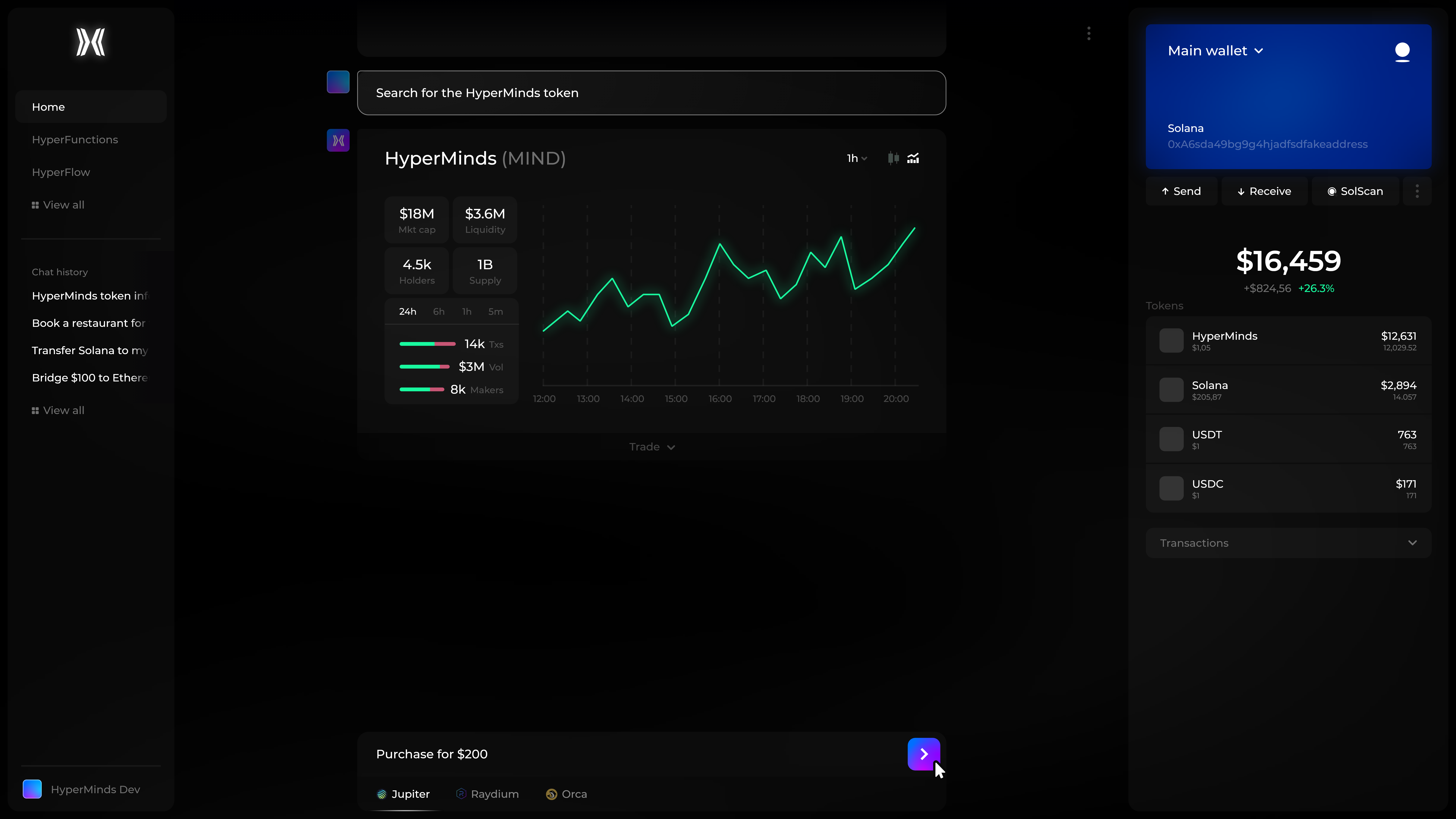
A system capable of handling any intellectual task.With many technical challenges still forming a barrier to achieve that goal, HyperMinds leverages the latest cutting-edge advancements in AI research to provide practical solutions. Applying our fundamentals listed below, HyperOS is the pinnacle of HyperMinds showcasing its latest innovations, providing a unified interface allowing humans to focus on ‘what’ instead of ‘how’.
HyperFunctions
The world’s first hybrid retrieval pipeline optimized for hyper-scalable function calling, allowing LLMs to approach Artificial General Intelligence.
HyperUI
Transform AI responses into rich, interactive interfaces with the standardized and optimized HyperUI framework.
HyperFlow
Automate intelligence and actions with event-driven AI workflows.
HyperSwarm
Agentic orchestration with fine-tuned models to handle complex tasks.